Showing posts with label Los Angeles. Show all posts

Wednesday, July 13, 2011

Happy 80th birthday Canter's


The Los Angeles Times had a nice story on Canter's today, they covered their 80th birthday on July 12 which was celebrated with 80 cent sandwiches just for the occasion. Last weekend I visited their original Boyle Heights location at 2323 Cesar Chavez (formerly Brooklyn Avenue). Its now a Kids Dental office complete with scary people dressed as clowns out front.

Friday, December 31, 2010

Happy New Year Los Angeles 1911!!

An option for celebrating the New Year in 1911 would have been dinner at Casa Verdugo. Hop on the Pacific Electric Railway and be dropped practically at their door. Ads of the day described Casa Verdugo with the words: convenient, appetizing, service, attractive, vintage, elegance, refined, dainty, ultra, gratifying and original. The first letter of each of these words spells out your destination: Casa Verdugo. For an excellent and informative lecture please check out Charles Perry's Culinary Historians of Southern California lecture on the history of Casa Verdugo.


Other New Year's ideas that year prove timeless - an ad asks that "When you dine tonight ask for California wine. Remember that a dollar spent for California wine means a dollar left in California, while a dollar spent for foreign wine goes out of the country."

When the dawn broke on the first day of the new year it was noted that 'Police Surgeons and Police Sergeants were disappointed in the numbers, respectively, of injured and intoxicated.' The celebrating crowds were larger than ever before, thousands of people thronged Spring, Broadway and Main Streets, but there were only twelve arrests made the whole night and all were for drunkenness. The population in Los Angeles proper was approximately 320,000 in 1910 and apparently the police were hoping for a little more excitement!!

Sunday, December 5, 2010

Happy Repeal Day everybody!


On this, the 77th anniversary of the repeal of Prohibition - Happy Repeal Day everybody!

How did Los Angeles celebrate repeal? As responsibly as they did any other day during prohibition - the Los Angeles Times reported-
'Hundreds of gallons of wines, whisky, brandy and other strong liquors were rushed to more than 10,000 retailers in Southern Califronia' but the anticipated rush to purchase 'failed to materialize' and drinkers celebrated quietly. Though beer still seemed to be very popular....

Saturday, December 4, 2010

Los Angeles sentiment during prohibition


Mirrored that of the nation from January 16, 1920 to December 4, 1933.

Wednesday, November 24, 2010

Green Lantern Fountains 1929-1931


On June 1, 1929 an announcement appeared in the Los Angeles Times which promised to revolutionize soda fountains in Los Angeles. The Green Lantern Fountains would fulfill all wishes you could have for your soda fountain; cleanliness (‘always spic and span – with an attendant to match!’), courtesy (with ‘action courtesy, not words’ not just a “Thank You!” with the check ‘there’s too much of that kind’. And not a ‘soda jerker’ in sight), good food and drinks (‘before long they will be famous all over the city for the tempting way they are served, for their flavor-quality and their variety’). This was not a new chain of stores, they were independently owned and operated by established druggists. All sundries were concocted ‘with a chef’s skill’ and ‘every fountain was serviced daily, insuring always fresh ice cream’ and the benefit of ‘chain store convenience and uniformity’. Every Green Lantern Fountain (sponsored by the California Consumer’s Company) was ‘rigidly supervised and frequently inspected to insure that these standards will be maintained’. Who knew there were so many filthy soda fountains run by unkempt folks in Los Angeles?

The president of the company, A.V. Wainwright, knew. The folks behind Green Lantern Fountain had interviewed hundreds of local women who were asked to describe their ideal fountain. Their answers spawned the new company which included experimental dietary kitchens and a training school for fountain attendants. And respondents requested that the ice cream doesn’t taste like ‘store’ ice cream. The Green Lantern ice cream was created in their catering kitchens and contained a high butter fat content which gave it ‘that rich creamy taste’.

Green Lantern Fountains formally opened at 8pm on the evening of June 1, 1929, signaled by the flashing of dozens of their signature lighted green lanterns and a ‘get acquainted offer’ of a 65 cent special ice cream brick for the low discount price of 40 cents. The brick was a combination of ‘creamy Vanilla ice cream, fresh orange juice Sherbet, and fresh California Strawberry ice cream. New specials seem to pop up every week. Mid-June 1929 saw a coupon for a 10 cent fresh peach sundae (any flavor of ice cream covered with fresh peaches, California walnuts, fresh whipped cream and a cherry), mid-August 1929 it was a chocolate ice cream soda for 15 cents, late-August it was ‘Fruit Bowl Week’, and then they began touting their ‘New Green Lantern malted milk’. There was always reason to celebrate at Green Lantern Fountains! From October 18-20, 1929 there was an Autumn Open House, celebrating the success of the chain’s first season. The ice cream brick that accompanied this celebration was concord grape juice sherbet and a layer of black walnut ice cream. Should you have money you’d like to invest- ‘in certain Green Lantern stores, ice cream and fountain sales had increased as much at 89.3% in 1929’ an ad boasted in February 1930.

The holiday ice cream molds were amazing, each slice in the brick of ice cream revealed a themed design. Halloween saw them come out with a ‘pumpkin center’ mold; at Christmas time there was a ‘bell-center’ mold; New Years’ brick held a layer of vanilla ice cream, a layer of frozen fruit nesselrode- rum flavor, and a layer of peach ice cream; for Valentine’s Day there was a ‘heart-center’ mold; St. Patrick’s Day held a ‘shamrock center’ mold; your Bridge tournament could feature a ‘Spade’ center of the finest black walnut ice cream; Easter held a ‘chocolate egg’ mold; Mother’s Day was a silhouette of mother done up in cherry-fruit ice cream; Independence Day saw the red, white and blue stripes of fresh Strawberry ice cream layered with Vanilla and Plum Fruit; Washington’s birthday held ‘frozen cherry fruit pudding within vanilla ice cream’.


By June 1930 they were gunning to give Orange Julius (which whipped up their signature drink in 1929 on Broadway in Los Angeles) a run for their money with the new Valencia Frost Crème – ice cream blended with frozen orange juice by the “electric whip”. Late summer 1930 found them touting Green Lantern sandwiches with ‘higher food value due to milk bread, fresh creamery butter, large slices, generous fillings.’ The last mention of the Green Lantern Fountains I found was an LA Times ad in June 1931 read ‘Goodbye Teacher, Goodbye School’ and featured the layers of Almond Nut (which always screams ‘School!’ in my mind), vanilla and fresh strawberry ice creams. I'm not sure what ultimately lead to their downfall....

Sunday, October 31, 2010

Halloween in Los Angeles - 1920s Part Five


Halloween 1928 - While most Los Angeles restaurants and clubs entice patrons with 'gamboling hobgoblins', 'fun, frolic and noisemakers!' and a 'confetti dance at midnite' - one locale gave a thumbs up to bad taste. Cliff Dwellers Cafe on Beverly promised 'Squaws and braves go on warpath tonight. It will be a massacre!'. The Roosevelt Hotel in Hollywood held their annual 'Hallowe'en' party with all the 'ghosts, goblins and Jim cracks that go with an old fashioned Hallowe'en'. I'm still scratching my head on the 'Jim crack' reference. The definitions for Jim crack/gimcrack that I've found refer to cheap and showy objects of little or no use (the thesaurus lists: gawdy, tawdry, trashy, tacky and tasteless). I assumed the Roosevelt (which would host the first Academy Awards in May 1929) was a little classier than that but perhaps movie stars preferred to 'slum' in beautiful surroundings. More mischievous merriment included a group of about 80 school children hurling a supply of eight cases of tomatoes at motorists passing by the intersection of Fairfax and Melrose. Just off of Melrose in the 600 block of Kingsley Drive, there was a report of a hose inserted under the front door of a home and turned on. Neighbors hearing a noise investigated and found a flooded living room, the water was turned off and the police were called.


Halloween 1929 - Blossom Room at the Roosevelt Hotel classes things up finally. Their Halloween Frolic features the music of George Olsen and 'It' Girl Clara Bow in attendance to present a trophy to the winners of the dancing contest. The Elite features special menus for Halloween - stuffed filet of sole au vin blanc, broiled French lamb chops, veal Porterhouse saute, sirloin steak a la minute, prime ribs of beef au jus, etc. Frankly, the only Halloween-like thing on the menu looks like its orange sherbet. The hygienic Green Lantern Fountains (more on them later) went all out for their first Halloween, creating a special combination of vanilla and orange ice creams that when you slice it 'each serving shows the golden pumpkin center'. The day after Halloween saw Santa's elves descend on the toy department at The Broadway on Fourth and Hill. The children (still probably high on sugar) were told that 'Santa has been so busy getting his toys ready this year that he can't possibly reach Los Angeles before Thanksgiving Day, so he sent just hundreds of his little Merry Workers to look after things until he arrives.' This bit of news taught me two things.
1. That its not just a recent phenomenon that the public has been pushed into the Christmas season earlier in the year.
2. That Santa is perfectly capable of making all the toys himself and needs a little chatter-free time to gear up for the holidays.

Wednesday, October 27, 2010

Halloween in Los Angeles - 1920s Part Three


Halloween 1924 - Thousands descended on downtown streets to celebrate. Early in the evening a red-haired 'Charlie Chaplin' ran amongst traffic and tried (unsuccessfully) to climb into the car of two beautiful young women. A 200-pound man dressed as a 'bottle baby' lead quite a crowd through the streets as he carried a huge bottle of milk. The Biltmore threw a swell shindig, it's ballroom and foyer decorated in orange and black. A highlight of the event was a novelty 'radium dance' complete with ballet girls in burlesque witch costumes, their bodies coated with phosphorus and carrying mechanical black cats.

Halloween 1925 - In Los Angeles all 950 police officers on the day watch were ordered to stay on duty throughout the night to 'prevent all destruction of property and undue annoyance of persons by those celebrating the occasion'. The Sheriff's 'dry squad' put quite a damper on festivities in Culver City by arresting fifteen Halloween revelers at the Green Mill and Nightingale cafes on Washington Blvd. The piers all celebrate. The Ocean Park Pier, in celebration of its first Halloween, gave special prizes (to the best costume I'm assuming). The Edgewater Club held a dinner dance for members with the Edgewater band providing the music. The Venice Pier ballroom once again hosted yama yama girls, Spanish dons, sheiks and assorted clowns. Chief of Police Andy Davilla welcomed all who sought a 'good, clean, wholesome time' but had no patience for 'the element which will insist on breaking laws.' By the end of the night more than sixty celebrants in Venice had been arrested for intoxication, reckless driving and disturbing the peace. With Venice and Culver City feeling the pinch why wasn't their any news of arrests in its sinful sister city, Vernon?

Monday, October 25, 2010

Halloween in Los Angeles - 1920s Part One


Halloween 1920 - a big spooks' ball is held at the Venice dance pavilion where modern witches in the form of black and orange yama yama girls mingled with goblins, fairies, elves, clowns and enjoyed joker bands. Many of film's elite (Tom Mix, Roscoe Arbuckle, et al) motored down to Tijuana where Baron Long's Sunset Inn promised Halloween frivolities, and of course booze, as 'a "spirited" program is assured in the Mexican village.'

Halloween 1921- dine and dance spot the Cinderella Roof at 6th and Olive held a Halloween Carnival complete with novelty hats, souvenirs and Rudy Wiedoeft's Famous Cinderella Orchestra. The Halloween menu included crab cocktail, hearts of celery, ripe olives, clear green turtle in cup, boned squab, chicken in nest, stuffed tomato, waldorf salad, neapolitan ice cream, petit fours and demi-tasse - all for the sum of $3 including couvert. Equal to about $36 in 2010. Thousands of costumed revelers thronged the streets of downtown. Every policeman on patrol became a "friend of the public" and watched the pleasure-seeking crowd with smiles instead of frowns. The Ambassador Hotel spent more than $1000 (equal to approximately $12,000 in 2010) on Halloween decorations and management supplied fortune-telling 'witches' to their guests.

Friday, October 15, 2010

Off the menu and into your home - Little Joe's


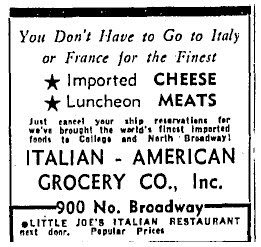
I came upon a curious factoid and had to delve deeper. Little Joe's, a famed Italian restaurant of yore, started life at 900 N. Broadway as an Italian grocery and delicatessen famed for it's imported cheeses and meats. When Little Joe's opened in 1927 this area was known as Little Italy. It's empty building is still here (though significantly altered from the original) and stands across from what is now called New Chinatown. More on the who/what/when of Little Joe's later but the restaurant apocryphally went through a 225 lb wheel of imported Swiss cheese every two weeks. Really? It must have been their formaggio fritto appetizer that did it. Glorified cheese sticks.

Little Joe's Formaggio Fritto

1 lb imported Swiss cheese
1 cup of flour seasoned with salt and pepper
2 eggs, well beaten
Oil for frying

Cut the cheese into strips/sticks, roll in the flour mixture, then into the egg and back into the flour. Heat the oil to 350 degrees and fry the coated cheese until golden brown. Drain on a paper towel laden plate and voila. Enjoy your fried cheese!

Tuesday, October 12, 2010

RIP - Raymond Taix, owner of Taix restaurant


Born just two years before his father Marius Taix opened Taix in 1927, Raymond Taix grew up in the restaurant business. The original location opened at 317-321 Commercial Street (near San Pedro Street) as a 'style pension bourgeoise - a real French dinner' just blocks from the post office during a time when European cuisine was very fashionable in Los Angeles (other 'European cuisine' establishments of the time included the Paris Inn, Marcell Inn, Brandstatter's Cafe Montmartre, Hotel Alexaandria's Franco-Italian Dining Room and Italian Village). Taix French restaurant featured 'typical French lunches and dinners served either family style or with waiter service'. In 1928 (during Prohibition) Marius Taix pointed out "It was to show that a French restaurant can be run successfully without serving wine that I started this one. It's a matter of sentiment too. My father started the first French bakery here in 1885. C'est tres interesant n'est ce pas?" Within a year of opening, Taix was bucking the trend of the usual dine and dance establishment that was popular at that time (a la Cafe Montmartre, Ambassador Hotel and Miller's Cafe Lafayette) with their slogan 'We sell you food , not MUSIC', they featured the cuisine and pointed out they had a seating capacity of 225. Drinking coffee from a water glass after the meal 'instead of a regular cup' was an odd feature of their service.
Raymond took over managing the restaurant from 1950 on and supervised their move to the current location in 1962. Eighty three years and this family owned business is still going strong. Viva la Taix!

Wednesday, April 14, 2010

Enjoy L.A. - Eat Out More Often! - La Villa Basque since 1960


I've got a list of places that are only open during the work week to hit up on one of those rare occasions I have such a day available. La Villa Basque has been on the top of that list for quite a long time. I was recently able to cross it off and it was definitely worth the wait. Located in the industrial hub of Vernon (only 90 residents were listed in 2008), and as a result it's easy to see why its only open during the week. The restaurant is owned by the town's (former) Mayor, the infamous Leonis Malburg, Vernon's native son. La Villa Basque serves lunch from 11-3 Monday through Friday and the dining room enjoyed a steady stream of partakers during my visit. I wholeheartedly recommend the croque monsieur (Virginia ham and melted gruyere cheese served on french toast with a side of pesto aioli), grilled beef and cheese on sourdough, their perfectly cooked shoestring fries and homemade potato chips. I will be back and I'm not the only one!

Monday, April 5, 2010

R.I.P - Edith Carissimi of Musso & Frank Grill

The Los Angeles Times featured a nice obituary on Edith Carissimi, the 95-year-old restaurateur that (until late 2009) co-owned the legendary Musso & Frank Grill. AKA 'Musso Frank' the restaurant is the oldest in Hollywood, its roots date back to 1919. Edith married into the Grill's 'family'. The original owners, Frank Toulet and Joseph Musso, sold the business in 1926 to John Mosso and Joseph Carissimi (Edith's father-in-law). Joseph passed the reins to Edith's (second) husband Charles and Edith became co-manager upon Charles' death in 1969. She had a pretty amazing life!

*** On a related note, do yourself a favor and read the interesting story of the restaurant's earliest years (when it was known as Frank's Francois Cafe) on page 100 of Gregory Paul Williams' fascinating book The Story of Hollywood which was published in 2005.

Sunday, February 21, 2010

Get thee to a newsstand


My favorite magazine devoted an issue to my favorite city. Every page of the March 2010 Saveur magazine focuses on the food, restaurants, recipes and dining history of Los Angeles. After reading it cover to cover some highlights for me were: a history of Vernon-based Tapatio Hot Sauce; the upcoming 72nd anniversary of Lawry's Seasoned Salt (of Lawry's the Prime Rib fame); Jeff 'Beachbum' Berry profiles Mike Buhen and Tiki Ti and includes a recipe for Puka Punch; the stories behind Philippe's mustard and Pacific Dining Car's steak relish; Bill's burgers in Van Nuys; Los Angeles as 'Deli Capital of the World' with Langer's, Brent's, Nate 'n Al and Canter's; and a baker's dozen of Saveur's favorite local food products- from Littlejohn's English Toffee to Kruegermann pickles.

Don't miss Patrick Kuh's Nights on the Town article which name check's La Rue's, Philippe's, Musso and Frank Grill, Ye Bull Pen Inn, Don the Beachcomber, Cocoanut Grove, Perino's, Romanoff's, Clifton's, Schwab's, etc....

Sunday, February 14, 2010

What Went Before? 217 W. 6th


While not much to look at on the outside, the inside of this four-story building in downtown Los Angeles is another matter entirely (see the interior photos at the Big Orange Landmarks blog, they turned out way better than mine did). This address has been known since January 1975 as Los Angeles Historic-Cultural Landmark number 137. A stroll through its doors reveal walls and ceiling covered in beautiful tiles by Ernest Batchelder which date back to 1914 when this location served as a confectionary shop/cafe known as Chocolate Shop #4 (more on the additional locations on a later post).

The building was leased in late 1913 by the Chocolate Shop Corporation (which consisted of E.C. Quinby, son P.W. Quinby and W.M. Petitfils) and work began to renovate the ground floor into 'one of the finest confectionary shops on the Coast' (renovation of the ground floor was estimated at $40,000 in 1913, which would be about $850,000 today). The three upper floors were to be changed into lofts.

Along with chocolates and the usual soda fountain confections, the Chocolate Shop locations also served lunch and dinner. This particular location served specials such as Filet of Sole a l'Orly and Saratoga Chips (aka fried fish and potato chips); Veal Curry with rice; fried Belgian hare with chasseur sauce; individual boneless chicken pies; and a vegetable dinner which consisted of a poached egg, potatoes, spinach, cauliflower and green peas.

In 1918 this location was immortalized in the Dorothy Gish film 'The Hope Chest' (see accompanying photo), in which Gish plays a girl who goes to work in a candy store to help provide money for her family when her father loses his job and ends up marrying her boss' son.

In 1922 the top three floors of the location were leased to the the Los Angeles Trust and Savings Bank next door and were used for the bank's trust department and an employee lunch/break room. The Chocolate Shop Corporation sold (or leased?) the ground floor Chocolate Shop to C.C. Brown (originator of the hot fudge sundae) who opened up a Brown's confectionary business in the location and urged former Chocolate Shop patrons to come in and get the 'Brown Habit'. Ads from the time called Brown's candies 'The Faultless Kind'.

In 1926 health food guru Paul C. Bragg (his company is still in business even after he is gone and is best known today for his organic apple cider vinegar) opened the second of his vegetarian Health Cafeterias, a 'Correcting Eating Cafeteria' at 217 W. 6th. They served 'non-clogging fruits and vegetables prepared in the Arnold Ehret way. The Health Cafeteria stayed in that location until at least late 1942 before Finney's cafeteria opened in the space and became the restaurant/cafeteria that most Angelenos remember fondly in this location. More on Finney's when I dig deeper....

Tuesday, February 9, 2010

R.I.P. - William Binder of Philippe's


I was sad to open the Los Angeles Times this morning and read the obituary of William Binder of Philippe's. Even if you're not a meat eater you've got to make the pilgrimage to Philippes, its always on the list that I give visitors to our fair city.
Mr. Binder married into the family that purchased the restaurant in 1927 from Philippe Mathieu. The original location fell to the bulldozer when the 101 freeway was built but Mr. Binder persuaded his father in law that the restaurant had life in her yet and they located in 1951 to their current location on Alameda. Do yourself a favor and please visit Philippe's, the Binder family has kept it true to its roots.
On a related side note- did everyone catch the Los Angeles Times article on Dolores chili brick in last week's Food Section? Dolores is the chili that is served (deliciously) at Philippes.

Wednesday, December 30, 2009

R.I.P. - Fred Harvey restaurant in Hollywood


Driving by yesterday my eyes did not deceive me, they are tearing down the Hollywood location of the Fred Harvey restaurant. This space has also been known through the years as Crush Bar, Continental Club and Hogie Club. The Fred Harvey restaurant sprung to life in April of 1939 and the building remained (fairly) recognizable until this week. What a shame! Check out LAPL's photo from the glory days.

Saturday, November 28, 2009

R.I.P. - Harry B. Vickman, Vickman's Feed Bag restaurauteur


Though he sold Vickman's restaurant at 1228 E. 8th Street in 1986 (the restaurant closed in 1993), Harry B. Vickman and his wife Barbara will forever be known as the faces of Vickman's Feed Bag (or 'Vickman's' as it became known) restaurant in downtown Los Angeles. Opening at 3am, Vickman's early morning catered to workers from the surrounding Produce District and later in the day became populated by Angelenos from all over the city who made Vickman's a destination. The bakery was legendary and their kiwi tarts helped popularize the fruit in the United States in the mid-1960s.
Vickman's dated back to 1919 when Harry's father Mordecai Vickman, then working for Baron Long at the Vernon Country Club, pooled $3000 with fellow VCC waiter James Ward and opened V & W Restaurant at 1st & Spring. Vickman's moved to their 8th Street location in 1930, Harry joined the operation in 1940 and his wife Barbara began working there in 1970 when Mordecai passed away.

Monday, August 31, 2009

R.I.P. - Kurt Niklas, restaurateur behind Le Bistro and Bistro Garden


The Los Angeles Times had an excellent obit on Kurt Niklas. Niklas arrived in the United States in 1951 and soon became Romanoff's head waiter and later maitre'd until the restaurant closed on December 31, 1962. Following advice from Mike Romanoff to garner investors (in addition to Romanoff's generous offer to hand over his liquor license and restaurant equipment) Le Bistro opened its doors in 1963 at 246 N. Canon Dr in Beverly Hills (now Mastro's Steakhouse). In 1979 Niklas opened the 'less formal' Bistro Garden down the street at 176 N. Canon Dr (now Spago).


Pictured: August 11, 1980- Ma Maison's Patrick Terrail, Le Dome's Michel Yhuelo, Bistro's Kurt Niklas and Jimmy's Jimmy Murphy attend a Thalians event at Scandia. Photo © Berliner Studio/BEImages

Monday, July 6, 2009

R.I.P. - Ethel Ustin, matriarch of Western Bagel


Ethel Ustin and her husband Dave opened Western Bagel in 1947, it's still going strong after all these years. They have 11 locations in Southern California and their main store on Sepulveda Blvd is open 24 hours a day.

Wednesday, July 1, 2009

Enjoy L.A. - Eat Out More Often! -Papoo's Hot Dog Show since 1949


Who can resist a place called Papoo's Hot Dog Show? This flagship location was once part of a chain of hot doggeries and opened the same year as it's neighbor, Bob's Big Boy. While the crowds for Papoo's aren't anywhere near as large as Bob's they are holding their own and celebrating their 60th birthday! I like Steve Doggie Dogg's review of Papoo's the best but one friendly word of warning- please do try the huge breakfast burrito if you're in the neighborhood but you might want to forgo the greasy, cooked salsa and opt for hot sauce instead.